Christopher Columbus

Who is he?
Christoforo Columbo, known to English speaking countries as Christopher Columbus was born in Genoa, Italy in 1451. When he was young, he studied mathematics, astronomy (study of the universe including space and stars), cartography (how to draw or produce maps) and navigation. He used all of this knowledge in his job as a trader (bringing things to trade with other countries by boat). Christopher Columbus is most famous for 'discovering' the Americas (North and South America). However, there were already people living there. But he was the first European to begin European settlements in the Americas.
What was his goal?
By the end of the 1400's there was high demand for things from Asia (like spices, silk and pottery) in Europe. It was very difficult to get to Asia from Europe. It was a long and dangerous journey to go by land, so Portuguese explorers were going all the way around Africa to get there.

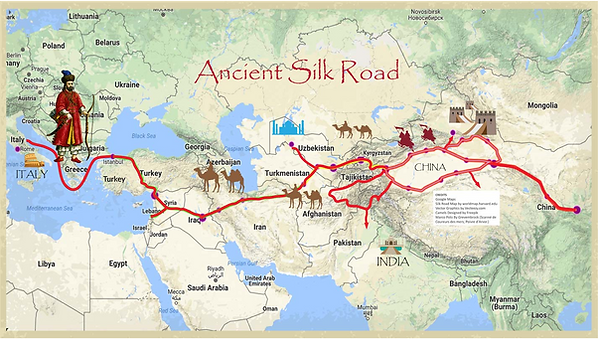
This was the old way to get to Asia from Italy. It was called the Silk Road. Travelling by land was very long and very dangerous.
This is what Columbus thought the world looked like.
Columbus knew the earth was round (he also thought it was much smaller than it actually is) and so thought it might be quicker and easier to get to Asia by going west instead of east. Of course no one had gone that way before, so this is what he was hoping. He created a plan and asked different rulers if they would give him enough money to try out his master plan. After many years of asking, the Spanish King and Queen (Ferdinand of Aragon and Isabella of Castile) agreed to give him the money he needed in 1492.
Columbus wanted fame and fortune. He also desperately wanted to prove people who doubted his plan wrong. He often agreed with any information that supported his plan but disagreed with any information that pointed out possible errors in his plan. Ferdinand and Isabella also wanted fame and fortune, but they also wanted to spread Catholicism across the globe. Columbus was also a Catholic so also wanted to share his religion with the world.
Ferdinand and Isabella agreed that Columbus could keep 10 percent of whatever riches he found, along with a noble title (like Lord or Duke), and he could be in charge of any lands he found.
Why did he want to achieve this goal?
Did he achieve his goal?
Columbus' goal was to get to Asia by going West instead of East. In August 1492, Columbus set sail from Spain with three ships (Niña, Pinta and Santa Maria), along with a crew and supplies to help them survive a long journey. As they sailed, Columbus kept two records; one was the distance he thought they had actually travelled and the other was a much shorter distance that he showed to the crew to trick them into thinking they hadn't gone as far from Spain as he thought. In early October 1492, the crew was losing hope and threatened to take over the ships and turn back if they didn't discover land in the next 3 days.
In the nick of time, the fleet of ships reached an island that is now part of the Caribbean Islands. Columbus called it San Salvador. The Indigenous people, called Taino people called it Guanahani. Even though the Taino already lived there, Columbus planted a Spanish flag in the ground and declared the land Spain's. At first, Columbus thought he had reached a part of South Asia called the Indies and so called the Taino people Indians. He then sailed to another Caribbean Island, now called Cuba. Columbus first thought he had reached Japan, but soon after convinced himself that Cuba was mainland China.

The solid red line is where Columbus and his fleet actually travelled. The dotted line is where he thought he travelled to.
Columbus asked all the Taino people where he could find gold. He found little bits of gold around but not much. Thinking he had succeeded on his mission to find Asia, Columbus wanted to go back to Spain and show all he had learned and found. He left 39 sailors to stay and live in and rule over Hispaniola (now Haiti and the Dominican Republic in the Caribbean). In January, 1493 he set sail for Spain. Ferdinand and Isabella welcomed Columbus home and he showed them gold, parrots, spices and Indigenous people he had taken as slaves. They were all so delighted they gave him all the titles they had promised and they were convinced to plan another voyage to Hispaniola for Columbus.
Columbus went to what he thought was Asia and back to Spain another couple of times. What he had actually discovered was the Americas (parts of the North and South American continents) . He never found the amount of gold and riches he had hoped for. Conflicts between Spaniards (Spanish people) and the Taino (Indigenous) people grew. Columbus never reached the glory that he first had received upon his return from his first voyage to the Americas.
How did he affect the Indigenous people?
The Taino people were the largest group of indigenous people in the Caribbean (the area where Columbus arrived). They had their own religion and systems for ruling their community. They were also skilled farmers and navigators, they wrote music and poetry in their own language and created art sculptures.
After Columbus arrived in San Salvador he was greeted by curious Taino people. Straight away Columbus and his crew traded with the Taino people. They traded metal things and glass beads for parrots, cotton and other things.
The arrival of Columbus and his crew had many negative affects on the Taino people. Columbus was determined to bring back gold and other treasures to the King and Queen of Spain so he and his men stole from the Taino people. He made them assist with building and hard physical work, he also made them mine gold for him to bring back to Spain for little to no money. Over his three trips back to Spain, Columbus kidnapped more than 550 Taino people in total to take to the King and Queen of Spain as slaves. Many of these people did not survive the journey to Spain.
The most terrible outcome of Columbus' arrival were the deaths caused by disease. The Europeans brought diseases that the Taino were not used to. These diseases spread quickly and killed many Taino people. In about 60 years, almost all Taino people had died from these diseases.